
SID: Integrated Defect System
SID records the defects detected at each stage of production at a multinational food company, so they can be removed precisely in the following stages and the defective product does not reach the customer.
- Industry
- Food (multinational)
- Duration
- 5 years
- Technologies
- Delphi, Oracle, OPC Server, SNMP, XML
The challenge
Production goes through several stages, and each one has its own inspection systems, the barrier systems. A defect detected in printing or lamination can only be removed further along, at the slitters and Doctors, and for that you need to know exactly where it is and on which roll.
The solution
For SID, I developed software for each stage of the process. It does not identify the defects, which is the job of the barrier systems. The system's role is to store what was identified, with a photo, the defect position and the roll, make it easy to query and pass the information on to the following stages. All data is kept in an Oracle database.
System screens
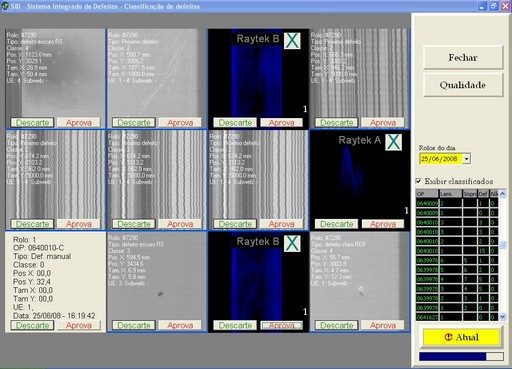
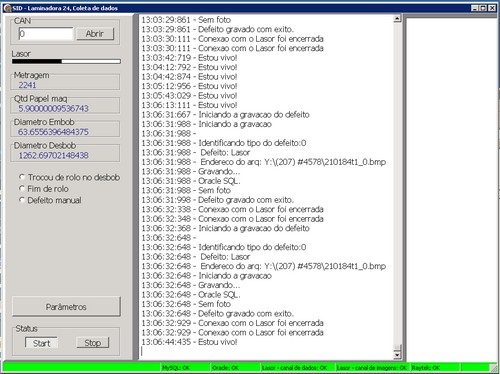
Click an image to enlarge it.
Process stages
Printing
Records the defects reported by the Futec barrier systems.
Lamination
Records the defects reported by the Raytek and Lasor barrier systems.
Slitters and Doctors
Receive the information collected in the previous stages so the defects can be removed.
Management and quality
Management (SNMP)
A management system based on SNMP shows which machines are on or off across the whole system.
Quality
Quality tests are also recorded.
Autonomous operation
The system works almost autonomously, with little human interaction. Data is collected by reading XML files and by acquisition from the barrier systems and the PLCs, through OPC Server.
Results
- Defects from the early stages removed precisely in the following stages.
- Lower risk of a defective product reaching the customer.
- Autonomous operation, with little human interaction.
- Project technologies adopted as a global solution.
Get in touchSee other projectsIndustrial automation software